Attuned to Pianos
Harvard Magazine
March-April, 2023

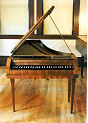
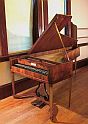

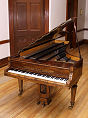


An Introduction to the Piano Collection by Edmund M. Frederick, Owner / Curator / Restorer
Courtesy of Daesik Cha
We continue hosting Piano Collection tours for groups and individuals, pianists and students, and members of the music-loving public. Tours can be scheduled by appointment, for most days of the week, by phone (978) 827-6232 or by email at piano.fred@juno.com. A typical tour takes three hours, due to the number and variety of pianos to be encountered; musicians frequently stay longer to explore the instruments in more depth.
See our Fall, 2026 schedule for dates, program details, and musicians’ bios and photos.
Admission is $20.00 per person, children and students, free. Season passes are available on request, offering six Fall, 2026 concerts for the price of five ($100.00) with a free guest pass, to introduce a new person to these concerts. Any unused portion of the pass will be counted as a tax-deductible donation.
One of the few positive offshoots of the pandemic is the newly expanded use of technology; all of our concerts are being recorded with video, and posted on our own YouTube channel, Music from the Frederick Collection. The high-fidelity audio, by our recording engineer, Christopher Greenleaf, is synchronized with his video footage, chosen from two camera angles by pianist/videographer, Daesik Cha, who also supplies the titles of the works being played. The resulting videos, posted a few days after each concert, make the performances available at any time, and at no cost, to those:
Concerts are held at the New Dawn Arts Center/Ashburnham Community Church, 84 Main Street (Route 12) at the corner of Chapel Street, Sundays at 3:00 PM. Admission is $20.00, students and children, free.
All pianos are from The Frederick Collection of Historical Grand Pianos.
Fall 2026 Schedule
| August 30, 2026 | Duo Fuerza: James D’León and Alwen Yeung, piano by Ignaz Bösendorfer, Vienna (1832). Four-hands Masterpieces by Schubert, Schumann, and Mendelssohn. |
| September 6, 2026 | Margarita Nuller, piano by Érard & Cie., Paris (1836). Mendelssohn, Schumann, Chopin. |
| September 13, 2026 | Ivan Gusev, piano by Joh. Baptist Streicher, Vienna (1846). Fanny Mendelssohn, Roman Khozeev, Chopin. |
| September 27, 2026 | Kalos Trio: Lijiong Liao, violin, Rebecca Hartka, cello, Barbara Lysakowski, piano by Érard & Cie., Paris (1893). Youthful piano trios by Debussy, Rachmaninoff, Dvořák. |
| October 4, 2026 | Yi-heng Yang, piano by Erard & Cie., Paris (1836). Beethoven, Schubert-Liszt, Chopin. |
| October 11, 2026 | Yukiko Sekino, piano by Érard et Cie., Paris (1840). Chopin. |
Our Historical Piano Study Center remains open throughout the year for visits and tours by appointment. Contact us at (978) 827-6232 or by email to make arrangements to visit.
|
The Brahms Age: Complete Johannes Brahms violin sonatas using historical instruments. Daniel Kurganov, violin, Constantine Finehouse, piano. Haenssler Classics record company. Sonatas One and Two were recorded with the J.B. Streicher und Sohn piano, Vienna, 1868, from The Frederick Collection. |
 |
Two new CD albums, 2022: |
|
|
Pianist Elaine Greenfield's two-disc set, Ravel Compared, was released on the Navona label. One disc, recorded with our 1893 Erard, shows the music on the samemake and model as Ravel's own piano; the other disc is of the same repertoire as itmight have been heard in the United States, on a 1917 grand piano by Ivers andPond, of Boston. |
 |
|
Pianist Yuan Sheng’s two-disc album of works by Schumann, recorded on our 1846 Streicher piano of Vienna, was issued on the Piano Classics label. Disc I: Davidsbündlertänze and Carnaval: Disc II: Kinderszenen, Waldszenen and Faschingsschwank aus Wien |
 |
Like our many other CDs, these albums are available for sale at the Study Center and concerts. We can also take orders by mail.
March-April, 2023
July-September 2021
September 7, 2015
October 13, 2016
September 8, 2015
June 1, 2015
May 4, 2015
Read all about it! We have been making the rounds in the print-realm. You may have noticed us in the Grove, or already heard about the commentary on our collection. Come see why we're the leading location for historic pianos in New England.

The Frederick Collection of Period Grand Pianos includes over twenty original pianos in playing condition, specifically, the sorts of pianos known to important composers from about 1790 to 1928. At present, there is no comparable collection of period, playing grand pianos in the United States. Most museum collections that include pianos focus on their decorative appearance rather than their musical value. Such instruments are rarely used for performance; perhaps two or three pianos in each of the other major collections in this country are maintained in regular playing condition.
For more information, see our articles on changes in piano keyboard ranges, a different perspective on piano history, or how a piano works.
Donations to Historical Piano Concerts, Inc., both in-kind and monetary, are much appreciated, for the support of the concert series, the work of the Study Center, and toward building renovations and maintenance.
The corporation is a non-profit, tax-exempt public charity under Section 501(c)(3) of the IRS Code; donations are fully deductible, and will be gratefully acknowledged.